



Atmospheric pressure plasmaPlasmaAPC 500
Corona treatment for plastics and elastomers
Partial activation of plastic and elastomer surfaces to improve bonding, printing and coating. As the process times are very short, ‘continuous objects’ such as hoses, cables, etc. can be pre-treated effectively.
Start an inquiry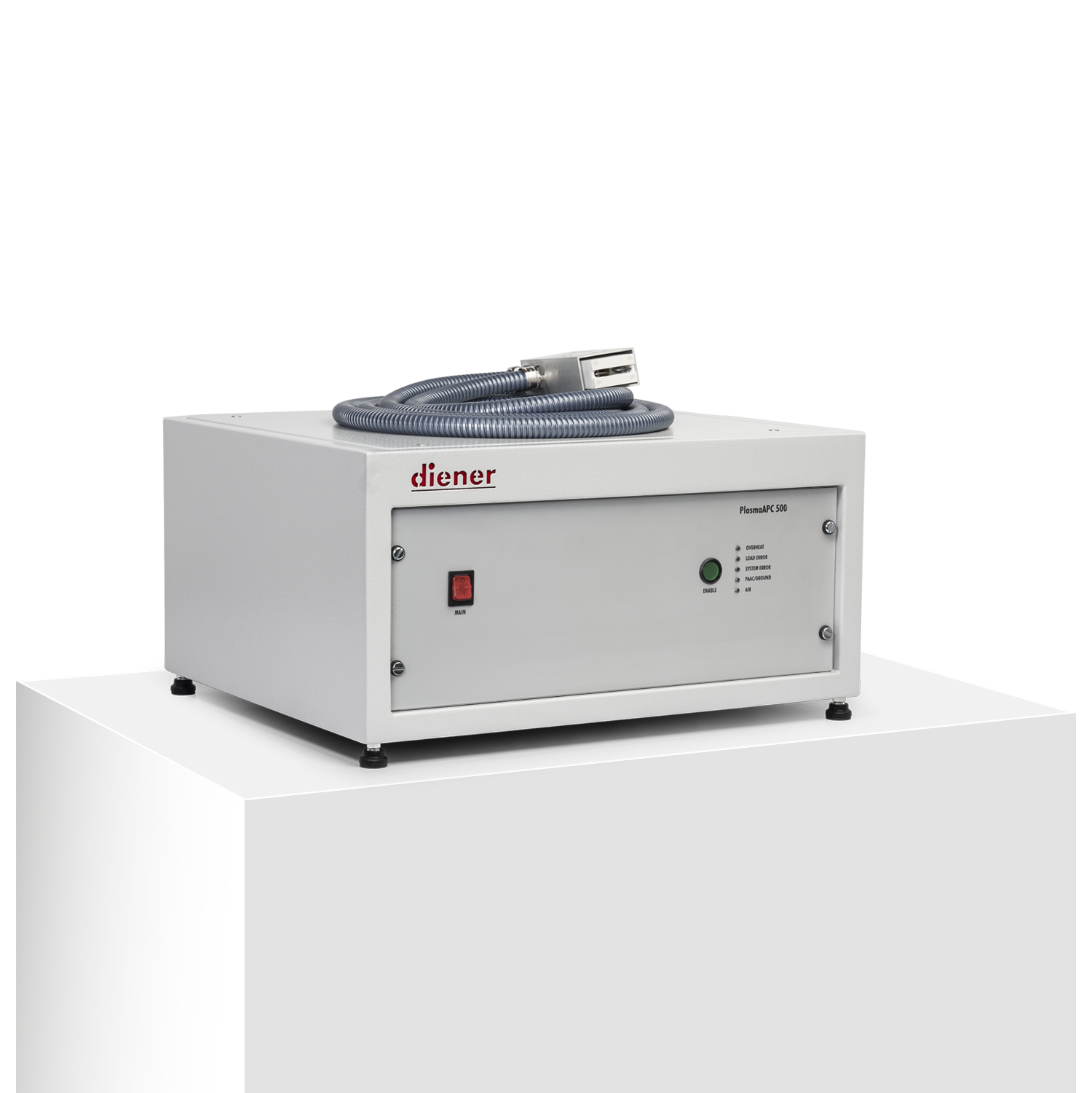
Atmospheric Pressure Plasma Corona Treatment (APC)
The use of the APC 500 from Diener electronic is a cost-effective method for activating plastic and elastomer surfaces. Air at atmospheric pressure is used as the process gas. A gas discharge is initiated between two electrodes in a non-uniform electric field using high voltage at ambient pressure. The voltage is approximately 10,000 V. The air flowing through the discharge zone is ionised. The plasma is blown out of the electrode area by the air flow. The substrate can be treated within the emerging corona. The treatment width is approximately 50–60 mm.
The corona process is well suited for the activation of ‘continuous objects’ such as: pipes, hoses, profiles, films and sheets made of materials that are difficult to wet, and can be used for pre-treatment prior to bonding, lamination, coating and printing.
However, as the gas flow is electrically charged, it is not suitable for conductive substrates. The arc and the electrodes are under high voltage – danger to life!

Cleaning
The Atmospheric pressure plasma system PlasmaAPC 500 offers a wide range of applications for the local ultra-fine cleaning of polymers, metals, ceramics and glass. This process breaks down molecular residues of contamination.
More information
Activation
Atmospheric pressure plasma is a highly efficient process for locally improving the adhesion of various substrates prior to painting, gluing, printing or bonding. Plasma activation using the Atmospheric pressure plasma PlasmaAPC 500 system creates polar bonding partners and increases the surface energy.
Technical data
Housing dimensions
Tabletop
Control unit
Manual control
Semi-automatic control
Dimensions Plasma nozzle
W 180 mm x H 60 mm x D 40 mm
Weight: 0.5 kg
Cable length: 3 m
Treatment width
approx. 50 - 60 mm
Generator
40 kHz | Power output 500 W
Power supply
230 V | 16 A
Technical changes reserved.
Get a custom quote for Atmospheric pressure plasma PlasmaAPC 500?
Start an inquiryOther interesting products
FAQ Frequently Asked Questions
For which material is the Corona PlasmaAPC 500 used?
One example of the use of the PlasmaAPC 500 from Diener electronic is the pre-treatment of ‘endless’ objects – such as hoses and cables – made from polymers or elastomers.
How wide is the treatment range for the Corona PlasmaAPC 500?
The treatment width for the PlasmaAPC 500 from Diener electronic is between approximately 50 and 55 mm per nozzle.
Which generators are required for the corona discharge in the PlasmaAPC 500?
The high-voltage generator in the PlasmaAPC 500 produces a voltage of up to 10 kV per nozzle, which is required to generate the electrical discharge.
Caution: High voltage! Do not touch either the electric arc or the electrodes!
Can I use the Corona PlasmaAPC 500 to treat electrically conductive components?
The PlasmaAPC 500 must not be used for conductive materials (metals, semiconductors). This is because the plasma discharge is completely exposed to the surface and must even come into contact with it.
The plasma jet from PlasmaAPC 500 is not potential-free!
Does the Corona PlasmaAPC 500 produce any exhaust fumes?
Yes, with this PlasmaAPC 500, ozone (O₃) formation is to be expected.
It is essential that the system is fitted with a good exhaust system!
Are exhaust air filters required for the PlasmaAPC 500?
Yes, all systems must be connected to a proper exhaust system, regardless of the type of gas used. Nitrogen oxides, exhaust gases, fine oil mist (from oil pumps), etc. are produced, which must not be inhaled; furthermore, the gases are often acidic, meaning they accelerate the rusting of surrounding parts, machinery and equipment.