


Atmospheric pressure plasma is suitable for a wide range of applications. Primarily, however, the systems are intended for local pretreatment of different surfaces, e.g. cleaning and activation of polymers, metals, ceramic, glass and hybrid materials. But the Plasma Jet process can also be used for coating. Thanks to their unique design, atmospheric pressure plasma systems by Diener electronic are suitable for use with robots and for integration in existing, automated production lines.
Plasma processes

Materials cleaning
Plasma technology offers solutions for any type of contamination, for any substrate and any post-treatment. In the process, molecular contamination residues are decomposed as well.
Learn more
Activation of materials
Good wettability is a prerequisite for the adhesion of binding partners in painting, gluing, printing or bonding.
Learn more
Coating of materials
With low-pressure plasmas, components can be tempered with various coats. This is done by supplying gaseous and liquid starting substances into the vacuum chamber.
Learn more
What is the design and functionality of atmospheric pressure plasma systems?
With atmospheric plasma technology, gas is excited by means of a high voltage at atmospheric pressure, such that a plasma is ignited. The plasma is expelled by compressed air from the nozzle. Two plasma effects are differentiated:
Plasma Jet process
Atmospheric plasma – PlasmaBeam
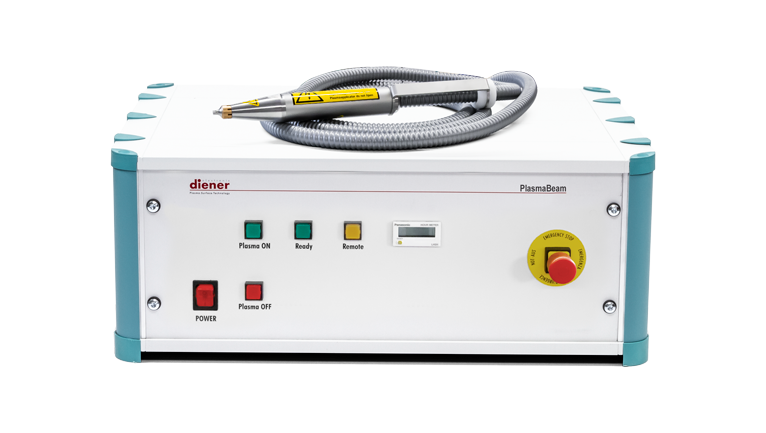
The system consists of three units:
Supply unit
Electrical mains connection
Process gas and cooling gas connection
High voltage generator
Current measurement block
Gas control block
Front panel with operating elements
Gas and power supply lines in a flexible pipe
Plasma generator
The central electrode, the distal electrode and the insulator form the discharge zone
The high voltage generator converts the mains voltage to high voltage (up to 10 kV) which is required for the generation of the electrical discharge.
The supply voltage and the process gas are supplied to the discharge zone via the flexible lines.
The air flow carries the active species (i+, e-, r*) created in the light arc out of the discharge zone (Plasma Jet process).
The specifically designed nozzle shape focusses the flow of the active gas onto the workpiece to be treated.
Gliding Arc process
Atmospheric plasma – Plasma APC

The system consists of three units:
Supply unit
Electrical mains connection
High voltage generator
Control block (control via micro-controller)
Front panel with operating elements
Air supply
Power and air supply lines in a flexible pipe
Plasma generator
Two electrodes form one discharge zone
The high voltage generator generates a voltage of up to 10 kV required for the generation of the electrical discharge.
The supply voltage is supplied via the flexible supply cable.
The air flow guides the electric arc from the electrode region. (Gliding Arc process)
The electric arc comes into direct contact with the surface.
Danger! High Voltage! Do not touch the electric arc or electrodes.
The PlasmaAPC 500 is used for non-conductive surfaces only.


Dry, oil-free compressed air 5-7 bar, approx. 1800 l/h

Supply unit incl. gas control block

Gas and power supply lines in a flexible pipe

Central electrode

Insulator

External grounded electrode

Plasma jet, free of dangerous high-voltage potential

Gas channel / gas flow

Electric arc

Voltage supply

High-voltage generator

Air compression
Supply unit
High voltage cable
Electrodes
Arc discharge plasma

Air supply
High-voltage generator
Voltage supply
FAQ Frequently Asked Questions
Is there a partial surface treatment?
PlasmaBeam enables localised surface cleaning without the need to mask off the surrounding area; for example, it can be used to clean Al, Au and Cu bond pads prior to Wire-Bonding without coming into contact with the rest of the surface.
What are the main benefits of treatment with atmospheric pressure plasma?
PlasmaBeam technology is suitable for in-line processes, e.g. plasma cleaning of continuous metal profiles and tubes prior to coating, gluing, bonding or painting.
This technology is suitable for use with robots, i.e. the 2- or 3-dimensional surfaces can be scanned with the plasma beam using robots.
PlasmaBeam enables localised surface cleaning without the need to mask the remaining area; for example, cleaning Al, Au and Cu bond pads prior to wire bonding without coming into contact with the rest of the surface.
Is low-pressure or atmospheric-pressure plasma the better solution?
When it comes to surface treatment at Diener electronic, there is no such thing as ‘better or worse’, but rather ‘suitable or unsuitable for the application’.
What is the service life of plasma cleaning using atmospheric plasma?
Unfortunately, it is not possible to give any universally applicable, reliable figures here. The shelf life depends on storage conditions, processing parameters and the level of contamination.
Examples:
- A humid atmosphere and elevated temperatures (above 20 °C) drastically reduce the service life of the plasma treatment.
- Following a feasibility test, repeated treatment can extend the service life of the treatment.
- As a general rule for metal, glass and ceramic surfaces, it is recommended that bonding, printing or coating be carried out within one hour of plasma treatment to achieve the best possible results.
- For plastics, the following service life applies to the plasma treatment:
- PA (with and without glass fibre reinforcement): 1–2 weeks
- PP, PE: We recommend further treatment within 1 to a maximum of 2 days
- PC: 2–5 days
- ABS, PC/ABS: 2–5 days
Please note that these are approximate figures. Depending on the manufacturer, significant differences may arise due to the use of additives and release agents.
Is atmospheric plasma generally recommended for surface cleaning?
Yes, but to a very limited extent. Low-pressure plasma offers significantly greater process flexibility when it comes to cleaning processes.
Can gas cylinders be purchased directly from Diener electronic?
No, that’s not possible.
What types of impurities can be removed?
All organic, film-like contaminants up to a size of approximately 1 micrometre can be removed using Diener electronic’s plasma systems.