



Low-Pressure PlasmaPlasma system Nano
Flexible plasma system for laboratories and industry
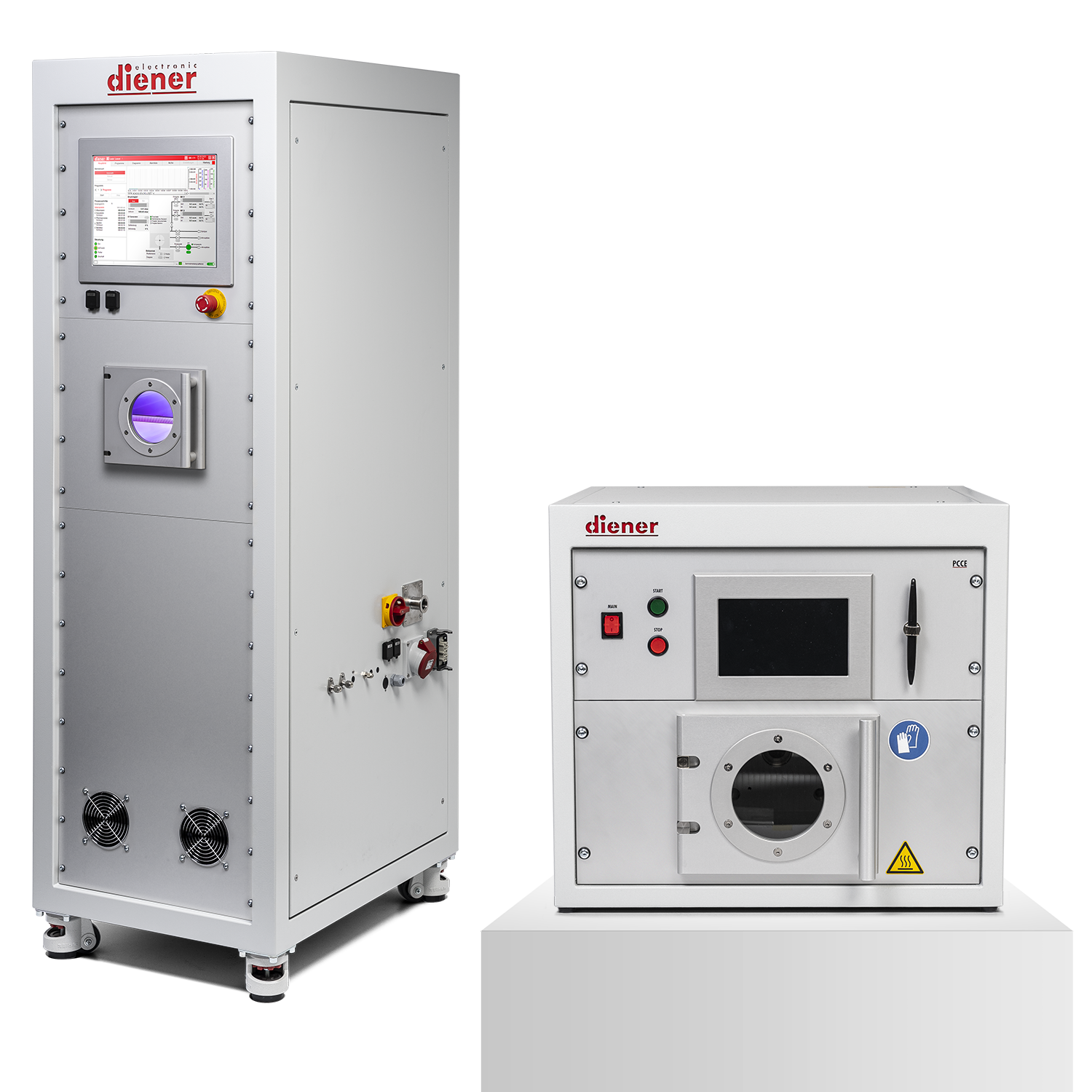
With a chamber volume of 18 - 24 litres, the Nano plasma system enables flexible plasma surface treatment. It combines the flexibility of a modular plasma system with the performance of an industrial plant.
Start an inquiry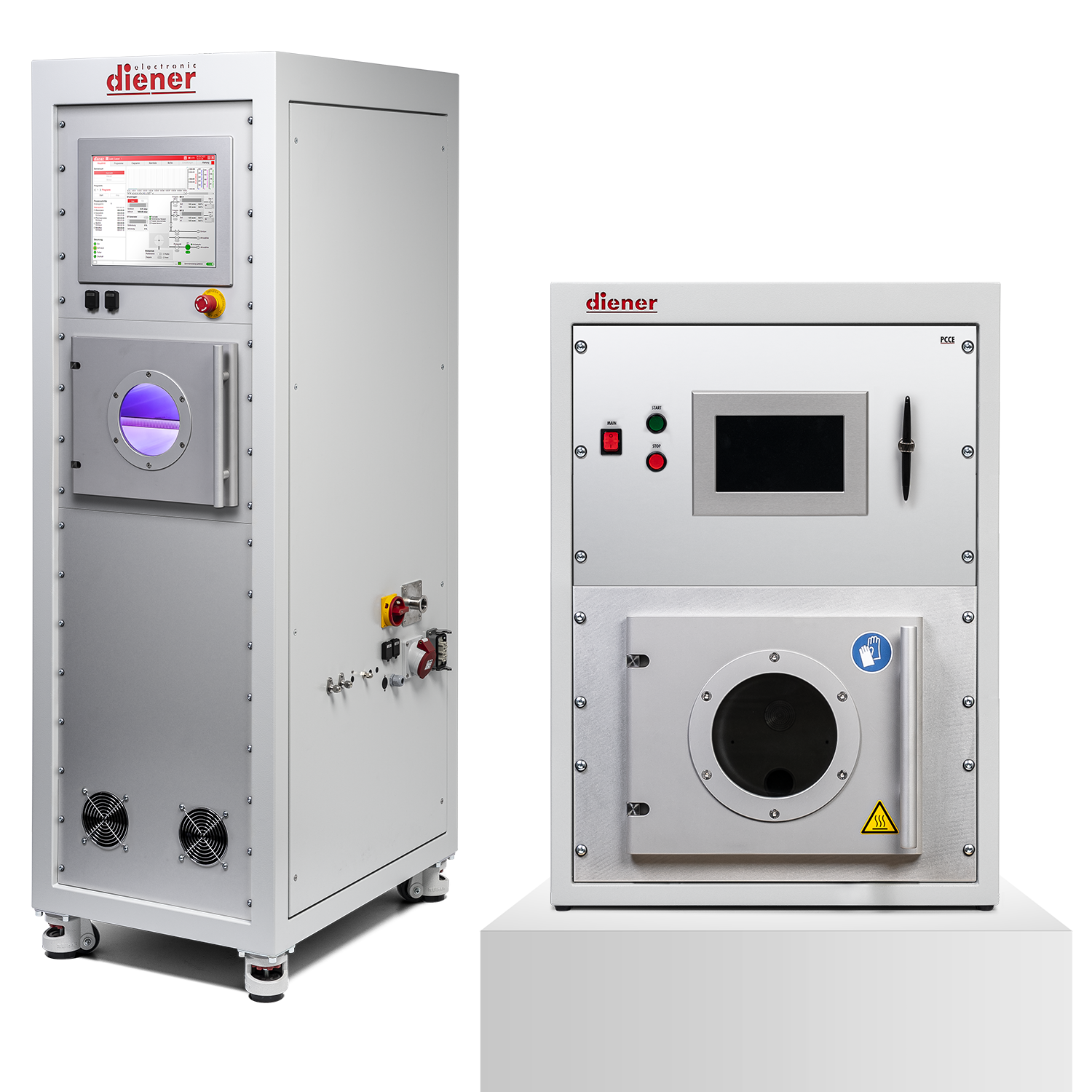
Plasma system for demanding applications
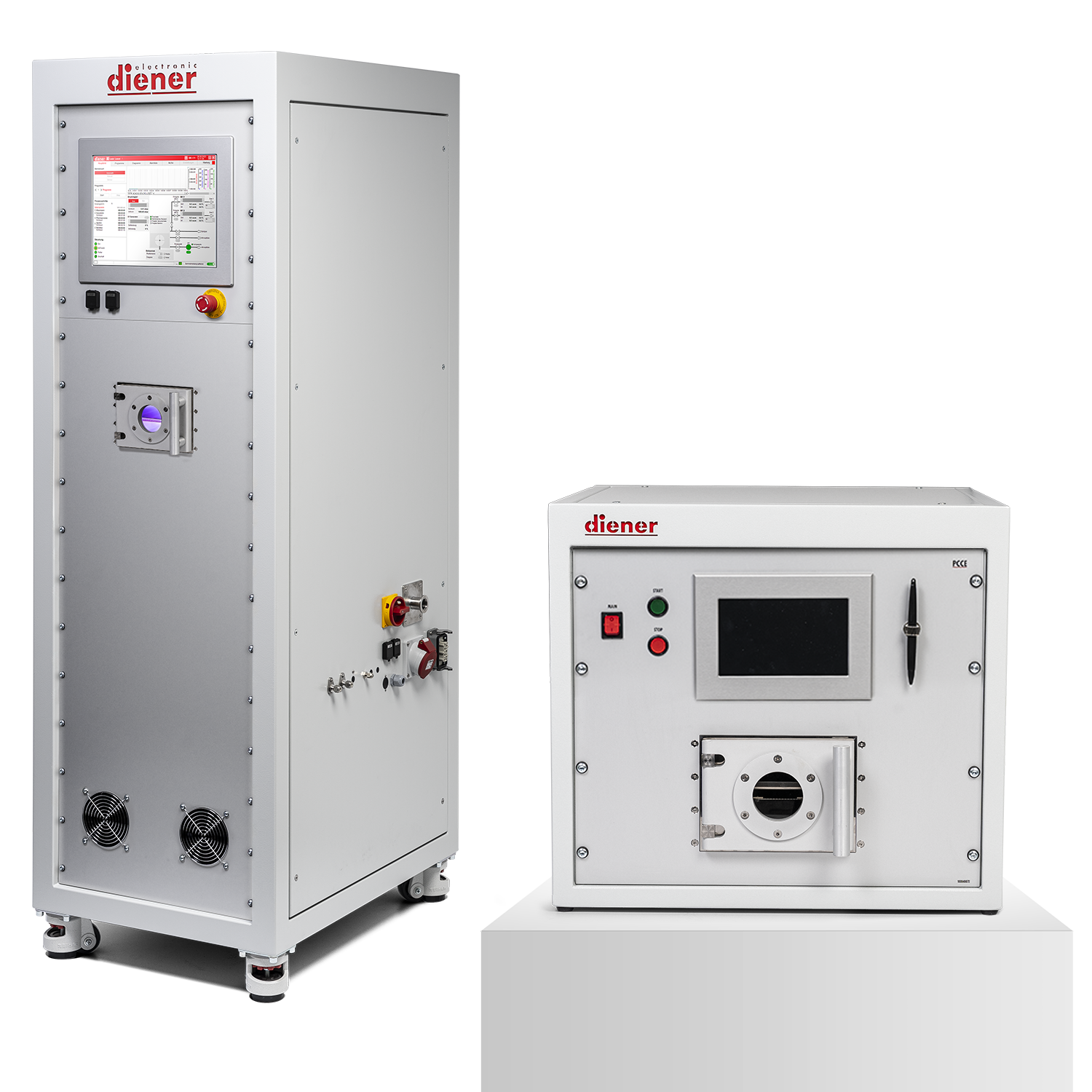
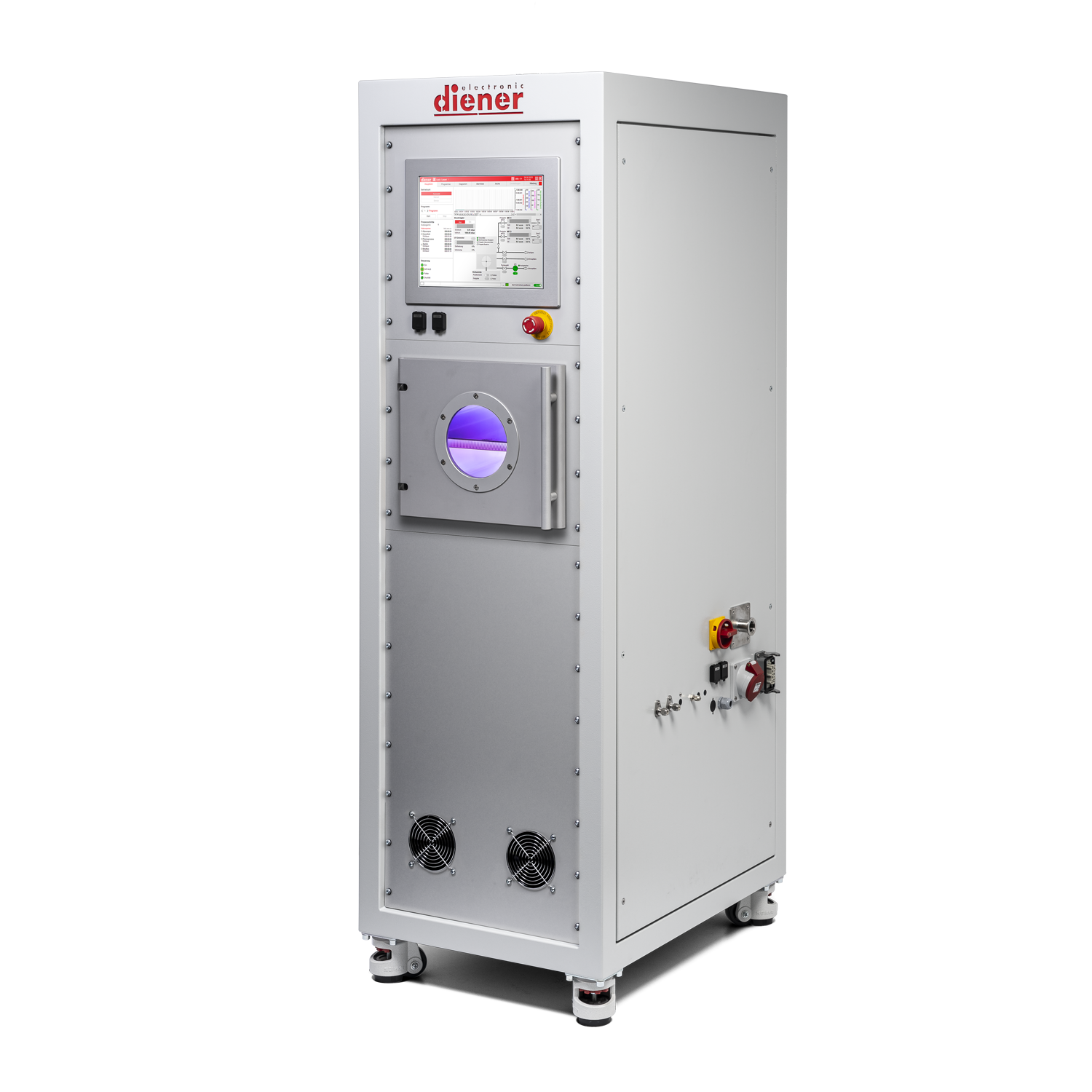
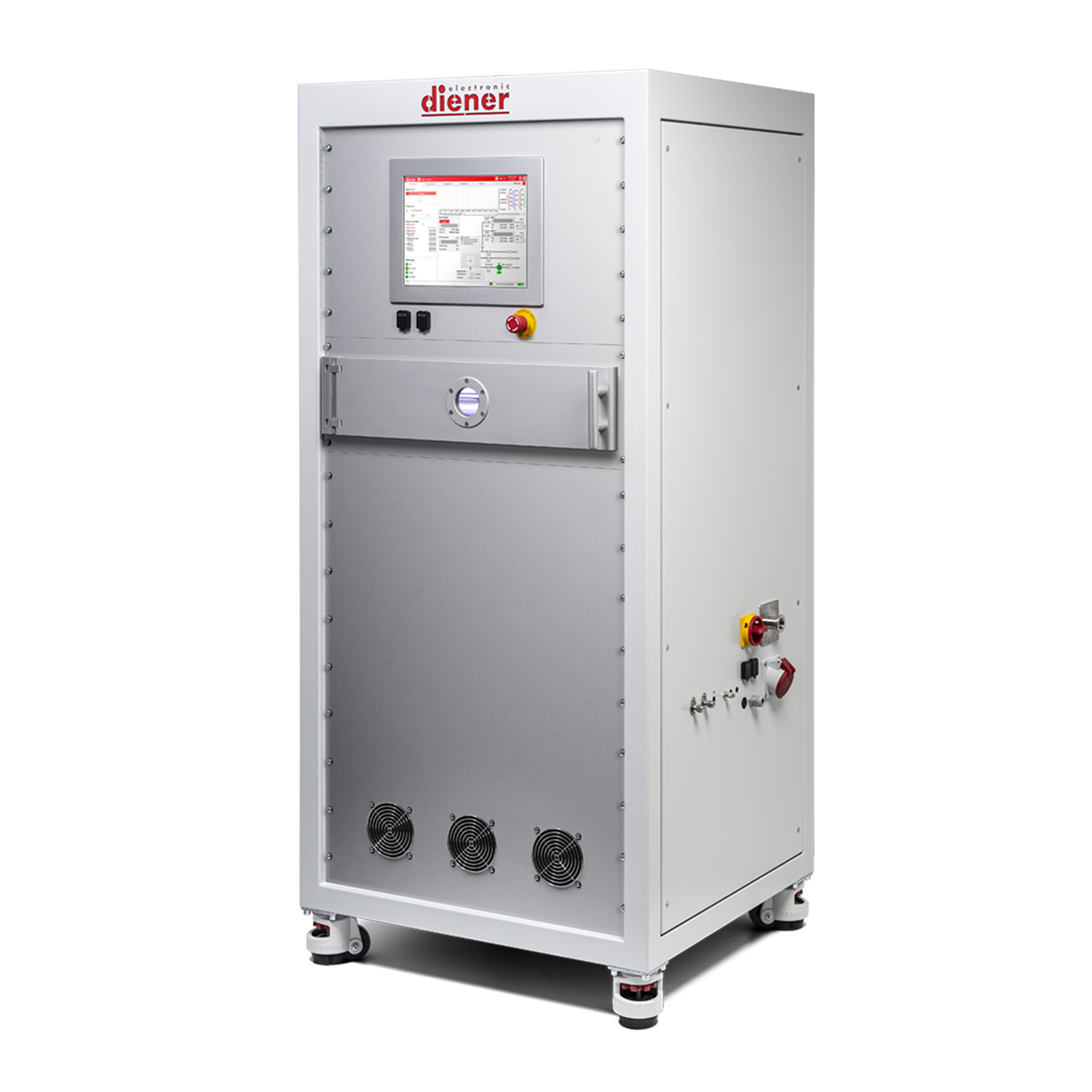
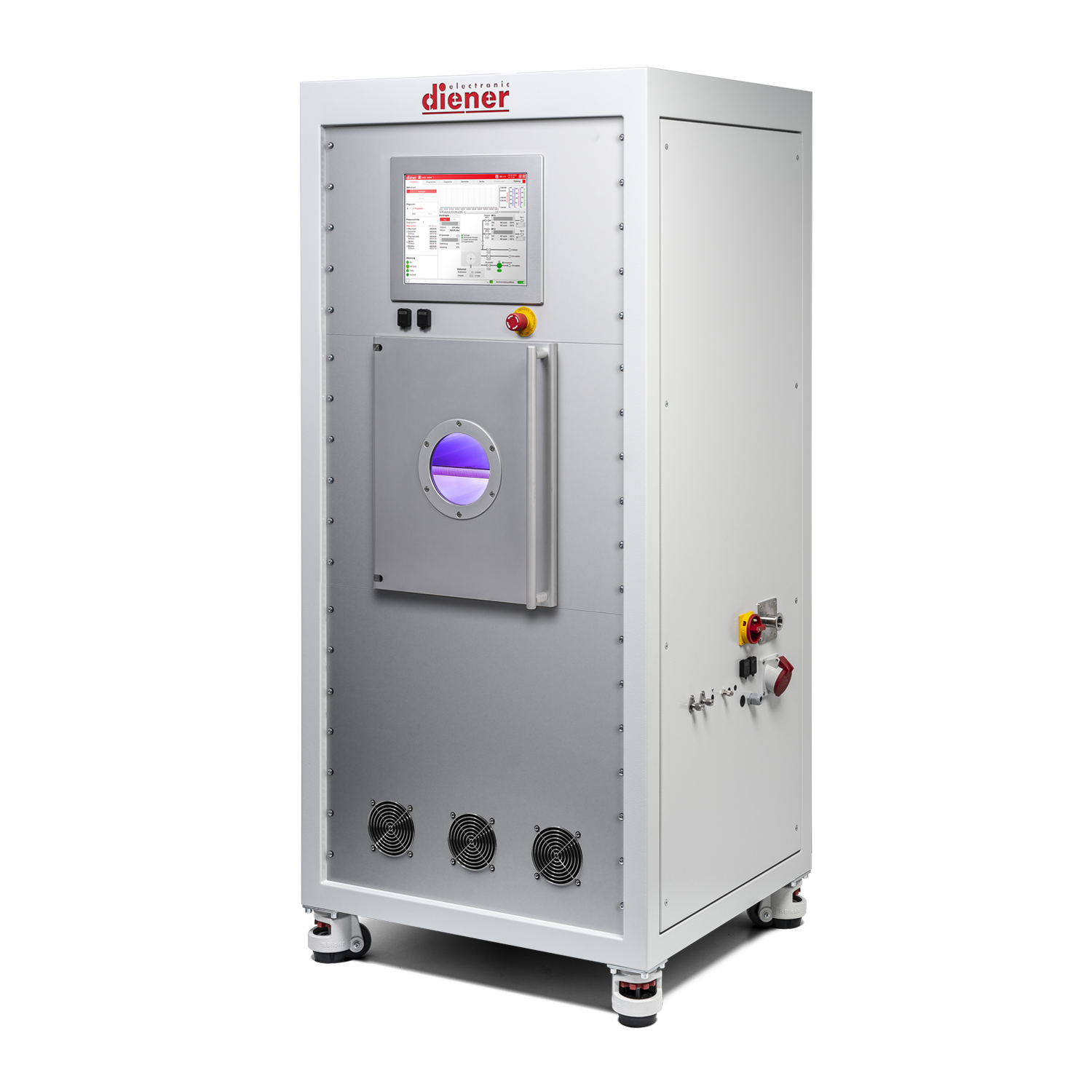
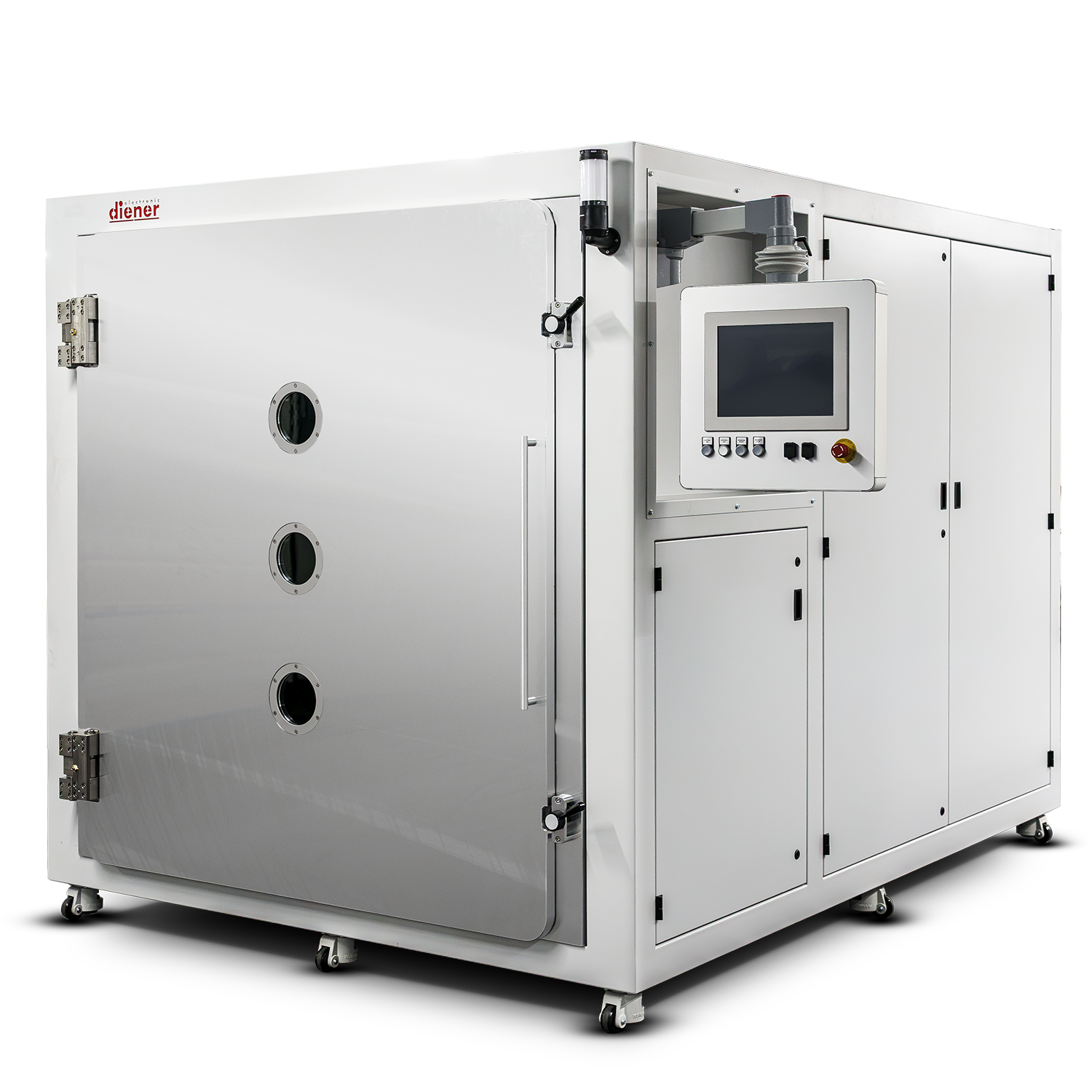
Depending on the application, the Nano plasma system can be configured either as a benchtop unit or as a floor-standing system. This offers maximum flexibility for integration into existing working environments.
With a chamber volume of 18 - 24, the Nano is suitable for medium-sized components and a wide variety of process requirements. The control options available are Semi-automatic, Low Cost PC, Basic PC and Full PC, allowing ease of operation and the scope of the process to be tailored individually to the respective requirements.
When using the Full PC control system, the unit can be easily integrated into an MES. Process data is documented and archived, ensuring complete traceability and a high level of process reliability.
The Nano is used across a wide range of industries – from analytics and semiconductor technology to medical, plastics and microsystems technology. It also impresses with its versatility in research and development departments and within the automotive sector.

Cleaning
The Low-Pressure Plasma system Nano offers solutions for ultra-precise cleaning of all surfaces, for every substrate, and for every post-treatment process. Plasma cleaning removes all organic residues without subjecting the component to chemical or thermal stress.
More information
Activation
Good surface wettability is a prerequisite for the adhesion of bonding partners during painting, gluing, printing, or bonding. Plasma activation using the Low-Pressure Plasma Nano system creates polar bonding partners and increases the surface energy.
More information
Coating
The Low-Pressure Plasma Nano system can also modify surfaces by applying a coating. Plasma coating can be used to deposit hydrophobic, hydrophilic, protective, or insulating layers of any kind.
More information
Etching
The plasma technology of the Low-Pressure Plasma Nano system enables anisotropic and isotropic etching. This results in the nanostructuring of surfaces, which increases their surface area and improves adhesion.
More information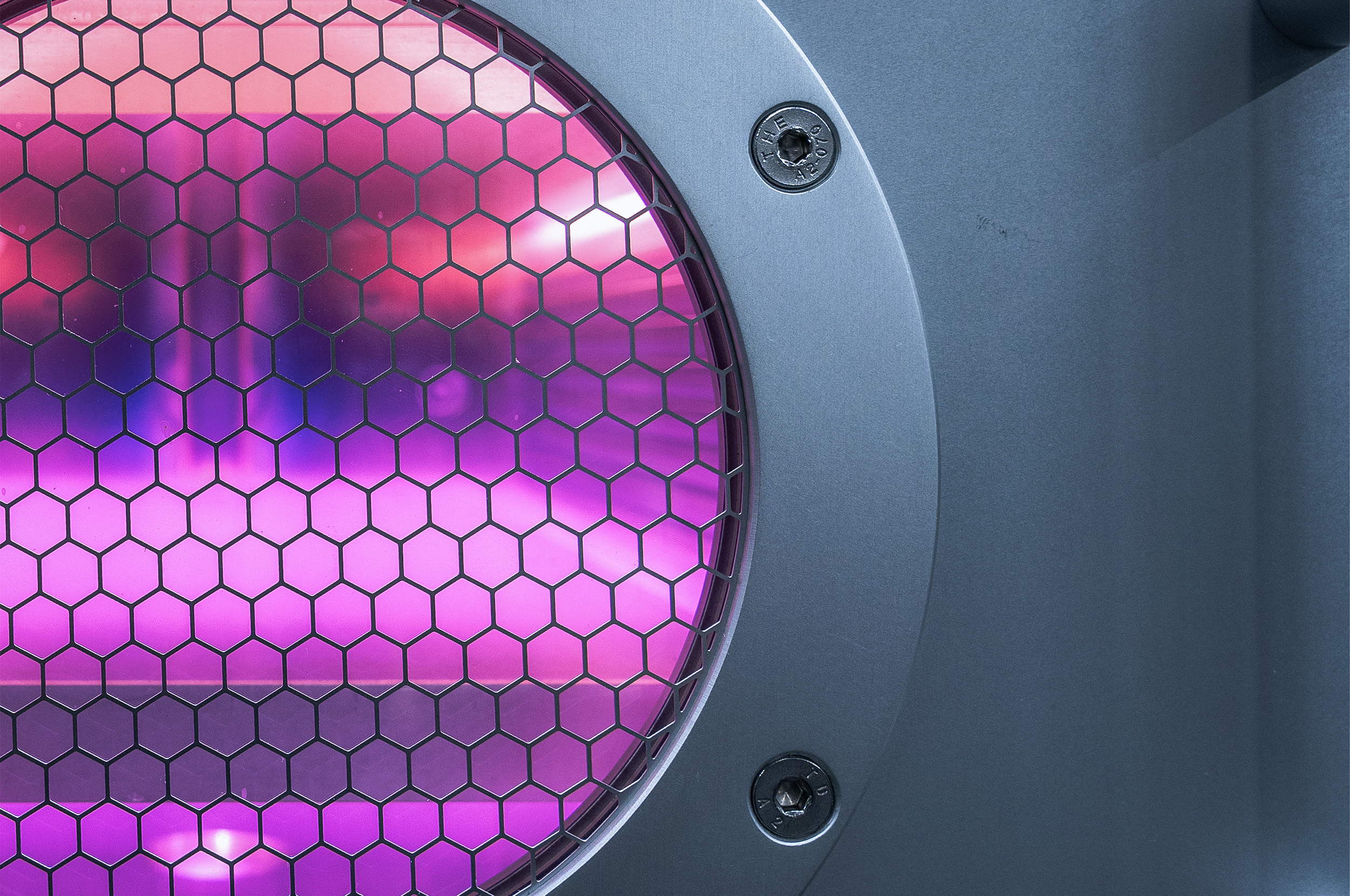
18 - 24l chamber
The Nano plasma system is equipped with a chamber volume of 18 - 24, which is ideally suited to complex industrial components. For applications requiring a high level of purity, chambers made of borosilicate or quartz glass are available. These offer impressive chemical resistance, ensuring a high level of process purity. They are ideal for applications in medical technology or laboratory work. For industrial use, stainless steel or aluminium chambers are available, which ensure particularly safe and stable industrial processes. For certain applications, a rotary drum is also available to ensure uniform treatment.

Modular system
The Nano plasma system can be flexibly configured using a modular system, which Diener electronic has developed over many years of experience and proven designs. To facilitate easy integration into an existing production environment, the Nano plasma system can be built into a compact benchtop housing or a sturdy floor-standing housing. The appropriate housing and control unit are selected depending on the chamber size. The result is a bespoke production system for industry with demanding applications.

Industry 4.0
To meet the growing demands of Industry 4.0, Diener electronic offers the Nano plasma system with an optional automatic door. This allows the plasma system to be quickly integrated into an MES and optimally incorporated into automated production lines. The option of automated loading and unloading reduces the need for manual intervention, thereby increasing process reliability and enabling reproducible processes. Thanks to this automation, the Nano plasma system ensures efficient quality control.
Control
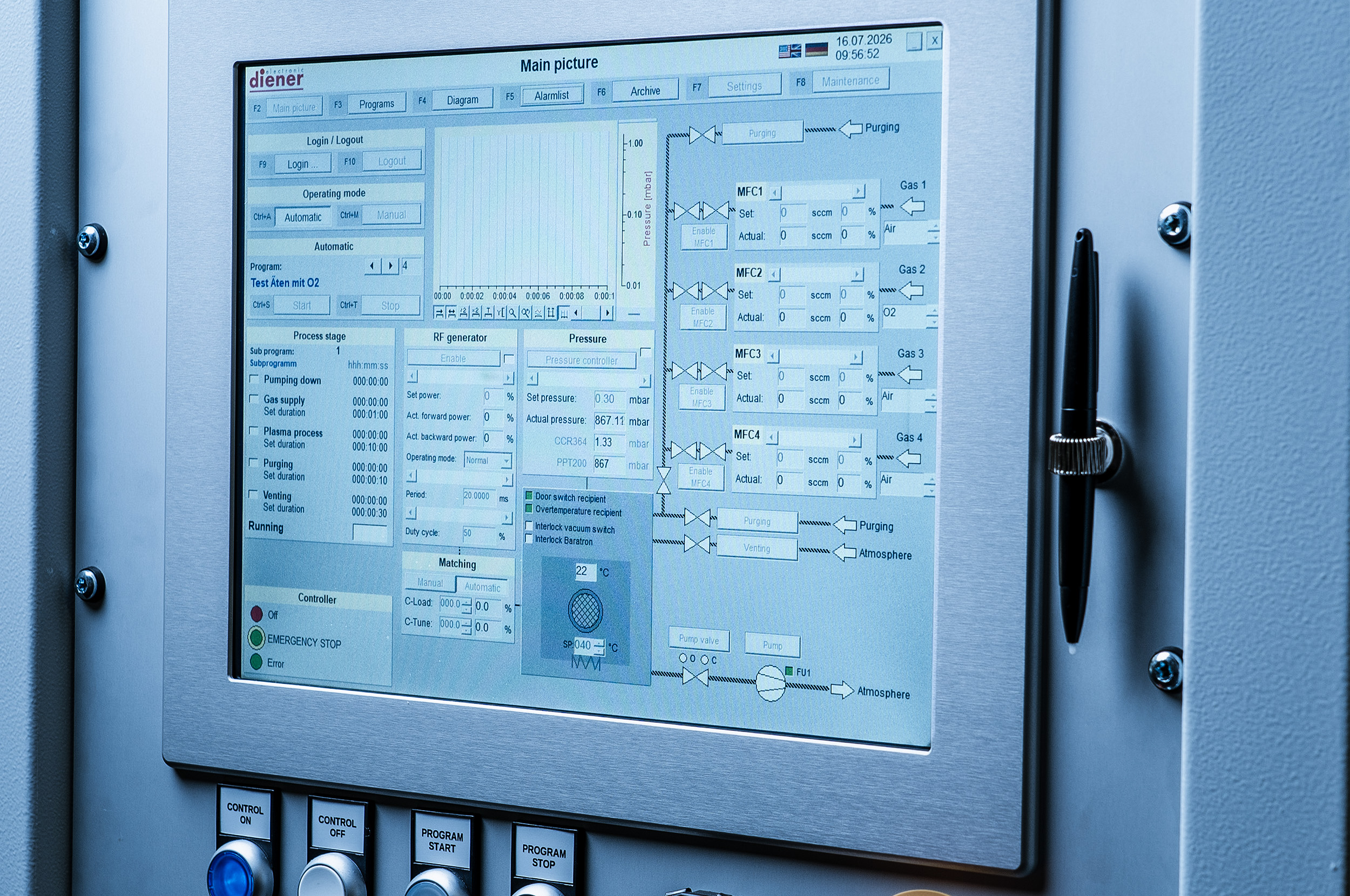
The compact design of the Nano in the benchtop unit offers a choice between the LowCost, Basic PC and a user-friendly semi-automatic control system. With the semi-automatic control system, the process parameters can be set manually, meaning that no prior knowledge is required to operate the system. For industrial applications, a robust floor-standing housing with a simpler Low Cost or Basic PC control system featuring pre-set processes is ideal. For demanding production environments, a full PC control system is available for the Nano plasma system. This provides process archiving, alarm logs and network connectivity. Process transparency and traceability form the basis for efficient and cost-effective production.
Technical data
Housing dimensions
Tabletop
Standalone
Control unit
Semi-automatic
Low Cost PC (Windows CE)
Basic PC (Windows CE)
Full PC (Windows 11 IoT Enterprise)
Vacuum chamber
Stainless steel, Hinged door
⌀ 267 mm x
D 420 mm; Volume approx. 24 liters
Stainless steel, Hinged door
W 240 mm x H 240 mm x D 420 mm; Volume approx. 24 liters
Aluminium, Hinged door
W 240 mm x H 240 mm x D 420 mm; Volume approx. 24 liters
Optional: Depth variably expandable up to max. 3000 mm
Quartz glass, Hinged door
⌀ 240 mm x
D 400 mm; Volume approx. 18 liters
Borosilicate glass, Hinged door
⌀ 240 mm x
D 400 mm; Volume approx. 18 liters
Workpiece holder / Part fixture
Flat substrate holder, Stainless steel
Flat substrate holder, Aluminium
Flat substrate holder, Quartz glass
Flat substrate holder, Borosilicate glass
Rotary drum, Aluminium
Flat substrate holder, Aluminium
Quartz glass boat, Aluminium
Generator
100 kHz | Power output 0 - 500 W
80 kHz | Power output 0 - 1000 W
13.56 MHz | Power output 0 - 300 W
2.45 GHz | Power output 0 - 600 W
Gas supply
MFC (Mass flow controller)
Needle valve
Electrode
For customer’s request
Pressure measurement
Pirani sensor
Capacity pressure gauge
Power supply
230 V | 16 A
Technical changes reserved.
Model variants

Nano
Model 1
Item No.: 1234561
Housing dimensions
TabletopW 540 mm x H 775 mm x D 800 mm
Control unit
Basic PC
Vacuum chamber
Aluminium
,
Hinged door
W 240 mm x H 240 mm x D 420 mm
Volume approx.
24
liters
Generator
100.00 kHz | Power output 0 - 500 W
Gas supply
3 x MFC (Mass flow controller)
1 x Needle valve
Electrode
Multi-tier electrode
Pressure measurement
Pirani sensor
Power supply
230 V | 16 A
Nano
Model 2
Item No.: 1234562
Housing dimensions
TabletopW 540 mm x H 775 mm x D 800 mm
Control unit
Basic PC
Vacuum chamber
Quartz glass
,
Hinged door
⌀ 240 mm x
D 400 mm
Volume approx.
18
liters
Generator
13.56 MHz | Power output 0 - 300 W
Gas supply
3 x MFC (Mass flow controller)
Electrode
Multi-tier electrode
Pressure measurement
Pirani sensor
Power supply
230 V | 16 A
Housing dimensions
Control unit
Vacuum chamber
Generator
Gas supply
Electrode
Pressure measurement
Power supply
Other interesting products
FAQ Frequently Asked Questions
Which surfaces can be activated using the Nano plasma system?
The Nano plasma system from Diener electronic can be used to activate the following surfaces: plastics, metals, glass, ceramics and textiles.
What connectivity options are available for the software control system on the Nano system?
With its full PC control system, the Nano plasma system from Diener electronic offers the following connection options, such as:
- higher-level control systems, e.g. via Profinet
- MES systems, e.g. via OPC UA
- Database connection via ODBC
Can the control software for the Nano plasma system be adapted to meet our requirements?
On request, we at Diener electronic can customise the full PC control system for the Nano series. Please do get in touch with us regarding this.
How much can be applied using the Nano system during coating?
The Nano system from Diener electronic can be used to apply a coating down to the lower micrometre range (< 1 micrometre).
Which gases can be used with the Nano?
The following gases can be used in the Nano and, more generally, in low-pressure plasma: O₂, N₂, Ar, ambient air, CO₂, H₂O vapour and forming gas
Are exhaust air filters required for the Nano?
Yes, all systems must be connected to a proper exhaust system, regardless of the type of gas used. Nitrogen oxides, exhaust gases, fine oil mist (from oil pumps), etc. are produced, which must not be inhaled; furthermore, the gases are often acidic, meaning they accelerate the rusting of surrounding parts, machinery and equipment.
Can ESD-sensitive components be handled using the Nano?
Yes, this is possible using low-pressure plasma of the Nano. A trial can be carried out in our process department on request.
What is the typical pressure range usually found in the vacuum chamber of the Nano?
The typical pressure range of the Nano is adjustable from 0.1 to 1.0 mbar, depending on the defined low-pressure plasma process.
What is the typical process temperature for the Nano in the vacuum chamber?
With the Nano from Diener electronic, the temperature is normally between room temperature and approximately 80 °C – depending on the component, chamber type, process time and load quantity. Higher temperatures can be achieved on request from Diener electronic using heating elements.
What is the frequency of the GHz system Nano?
The generators for the GHz system Nano operate at an ISM frequency of 2.45 MHz – comparable in intensity to that of a microwave. Please enquire about the safety guidelines for people with pacemakers.